

Pfizer Document Lists Hantavirus as Side Effect of Covid Vaccine
The Pfizer document they tried to hide lists hantavirus as a covid vaccine side effect . Now it’s killing people.

What Happened - A court-ordered FOIA release of Pfizer’s internal post-authorization safety documents reveals hantavirus pulmonary infection was listed among 1,233 adverse events of special interest requiring post-vaccine surveillance, a document Pfizer fought to keep hidden from the public for years.
Why It Matters - The document resurfaced this week as a deadly hantavirus outbreak aboard the MV Hondius cruise ship has killed three people and triggered an international health emergency, prompting renewed questions about what Pfizer and regulators knew and monitored.
Bottom Line - The FDA wanted 75 years to release this data. A federal judge gave them eight months. Americans are still finding out what was in it.
A Pfizer document that the FDA tried to keep hidden from the American public for 75 years is back in the news this week, and the timing has people asking questions.
The document is officially titled the “5.3.6 Cumulative Analysis of Post-authorization Adverse Event Reports of PF-07302048 (BNT162B2) Received Through 28-FEB-2021.” It is a post-marketing safety analysis Pfizer submitted to the FDA covering the first months of the COVID-19 vaccine rollout. The FDA initially sought to withhold the full document from public release for 75 years. A federal judge ordered it released within eight months following a lawsuit brought by Public Health and Medical Professionals for Transparency, a group of more than 30 professors and scientists from Harvard, Yale, Brown, and UCLA.


On page 33 of the document, in Appendix 1, hantavirus pulmonary infection appears among 1,233 conditions listed as adverse events of special interest requiring post-authorization surveillance. The list was compiled under regulatory requirements from the CDC, FDA, EMA, and the Brighton Collaboration, representing conditions regulators required Pfizer to monitor and report on following the vaccine’s emergency use authorization.
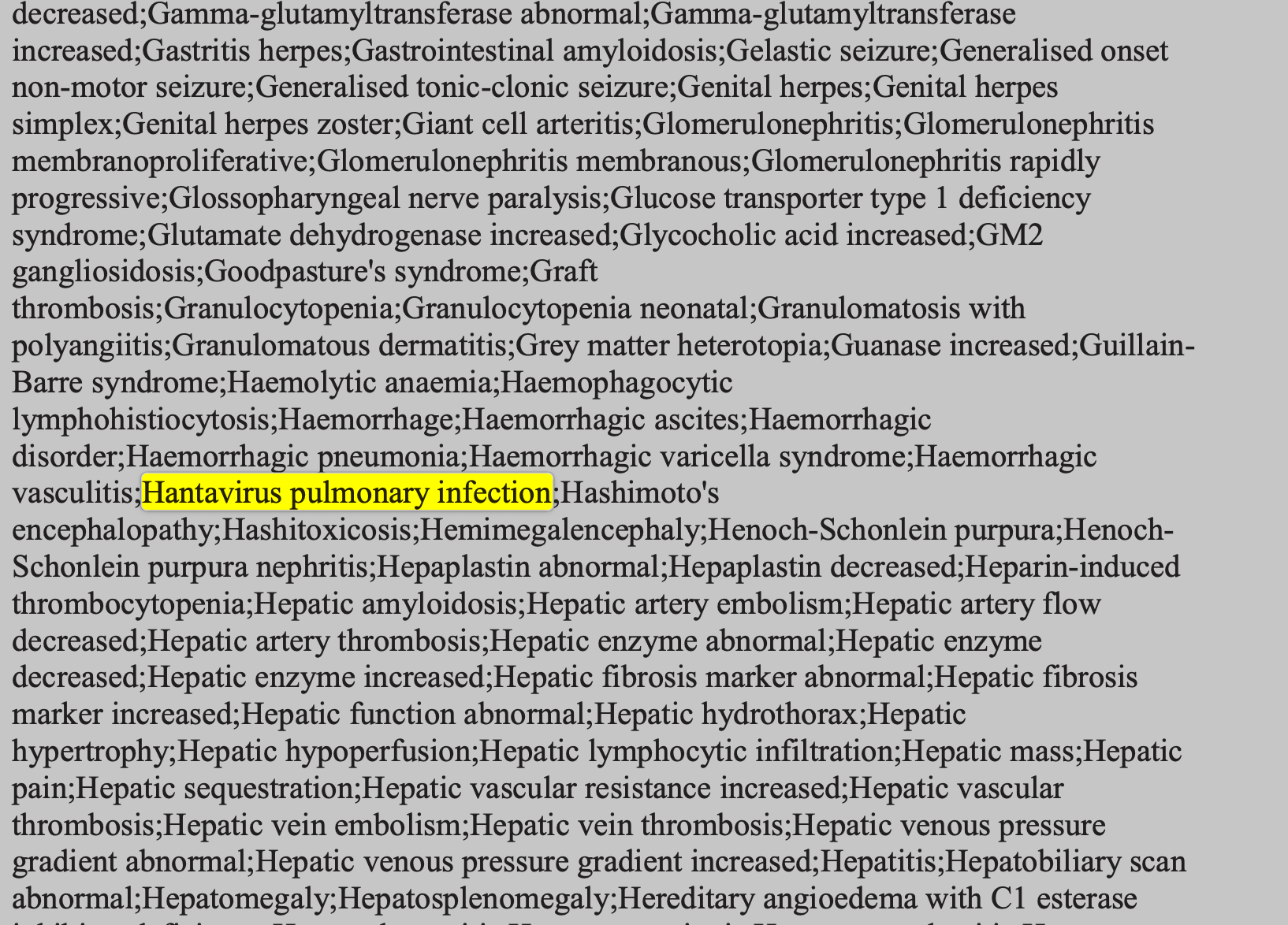
The document went viral this week as a deadly hantavirus outbreak aboard the Dutch expedition cruise ship MV Hondius has killed three people, infected at least five more, and triggered an international health response spanning more than a dozen countries. The outbreak is the first recorded hantavirus event aboard a cruise ship in history.
The resurfacing of the Pfizer document raises a straightforward question that deserves a straight answer: why was hantavirus, a rare rodent-borne illness with fewer than 900 confirmed U.S. cases over 30 years, flagged for post-vaccine monitoring in the first place?


The FDA and Pfizer have not addressed that question publicly. What is known is that the AESI list was compiled by expert regulatory bodies as a broad safety net, designed to capture any condition that appeared at unusual rates following vaccination so that signals could be investigated quickly.
What is also known is that Pfizer fought to keep the document sealed for three quarters of a century. It took a federal lawsuit from three dozen scientists at America’s most prestigious universities to force it into public view. The FDA, the agency responsible for protecting the American public, stood on the other side of that lawsuit arguing the documents should stay buried.
Americans are still reading through what was in them. This week, one entry on page 33 is getting a second look.
I wonder if it was also a side-effect of Moderna, and the other poison....I mean safe-and-effective-shots.